The Question Order That Makes AI Answers Sharper
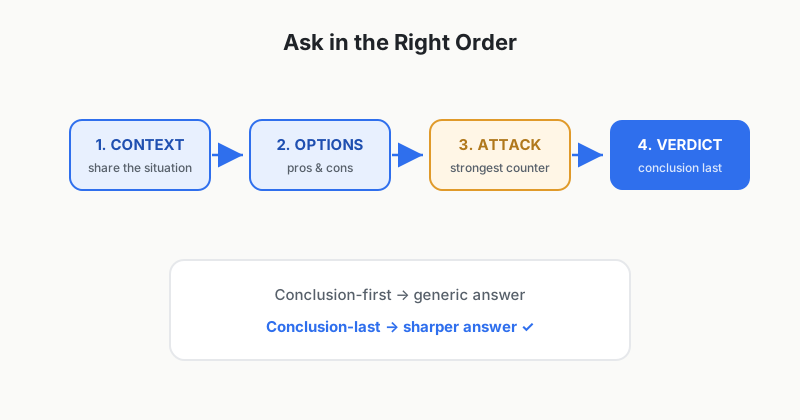
In a conversation with an AI, earlier turns shape later answers. So even if you ask the same things, shouldn't the order change the quality of the final answer? I took one judgment problem — "should my team adopt one remote-work day per week?" — and ran it through three different orderings, each in a fresh chat, then compared the final answers.
The three orderings I tested
A. Straight to the conclusion
"Should we adopt one remote day a week? Give me a conclusion and your reasons." — done in one shot.
B. Context first, then conclusion
Share the team's situation first (headcount, roles, recent issues) → ask for pros and cons → request the conclusion last.
C. Cross-examination
Start like B, but add two steps before the conclusion: "construct the 3 strongest arguments an opponent of this policy would make" → "can you rebut them?" → then request the final conclusion.
Comparing the results
| Ordering | Character of the final answer |
|---|---|
| A. Straight to conclusion | Generic. Pros and cons that fit any company, ending in "recommend a pilot." Not bad, but shallow |
| B. Context first | A conditional conclusion that reflected our team's actual issue (new-hire onboarding). Clearly more tailored than A |
| C. Cross-examination | The sharpest. It conceded one counterargument (loss of collaboration density) as "not rebuttable" and built a compromise plan around that risk |
The decisive moment in C was when the AI admitted it could not rebut a counterargument it had constructed itself. In A and B, that weakness got buried as one line in a pros-and-cons list; in C, it became the central condition of the conclusion.
Why the difference?
An LLM builds its next answer from the entire conversation context. In A, the only material is a one-line question, so the answer converges on the average of the training data. In C, the conversation has accumulated rich material — our situation, strong objections, attempted rebuttals — before the conclusion is formed, so the answer comes out specific and honest. There's also a tendency to defend a conclusion once stated, which means asking for the conclusion last works in your favor.
What I learned — a 4-step formula for judgment questions
- Give the context first (before asking anything)
- Have it lay out the pros and cons of each option
- "Construct the strongest counterargument, then try to rebut it" — this is the key step
- Only then ask for the conclusion
Bonus finding: if step 3 produces an argument that survives rebuttal, that argument is your real risk. This byproduct was often worth more than the conclusion itself.