Korean vs. English Prompts: Testing a Popular Belief
"Prompts work better in English." If you've spent any time in AI communities, you've seen this claim. It sounds plausible — most training data is English — but how big is the difference, really? I ran 6 tasks with matched Korean and English prompts and compared.
Method
- 6 tasks: 2 knowledge explanations, 2 writing tasks (with Korean output requested), 1 coding task, 1 image generation
- Prompts with identical meaning prepared in Korean and English (written naturally, not machine-translated)
- All text tasks used the same condition: "Answer in Korean"
Results: it depends on the task
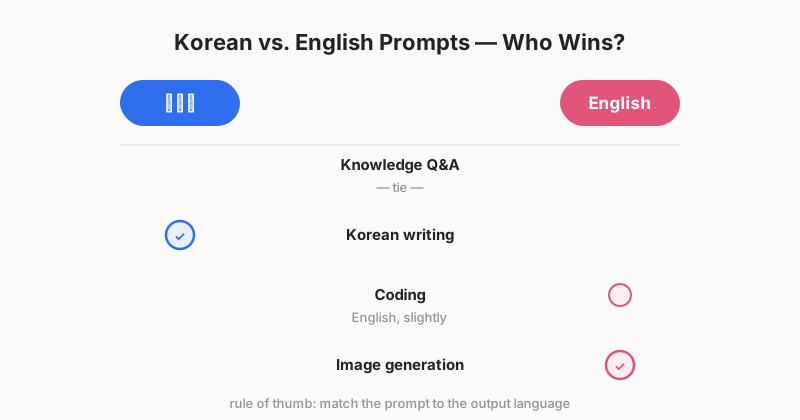
Knowledge explanations — virtually no difference
On questions like "explain quantum computing to a high schooler," I couldn't detect a quality gap. The latest large models' Korean comprehension is already more than enough for tasks at this level.
Writing in Korean — the Korean prompt actually won
This was a fun reversal. Requesting a "friendly tone" in English and receiving Korean output produced more translationese and awkward choices between formal and casual registers. A Korean prompt like "write it the way a friendly older neighbor would talk" preserved that nuance — and that subtlety was actually harder to convey in English. If the output is Korean, a Korean prompt has the edge.
Coding — English slightly ahead
On a Python web-scraping script, the English prompt produced slightly more thorough error handling. Makes sense — programming resources are overwhelmingly English. But it was nowhere near "Korean prompts produce broken code," and getting comments written in Korean was a genuine perk of the Korean prompt.
Image generation — English clearly ahead
The widest gap of all. For the same scene description, the English prompt captured details (texture, lighting) far more faithfully, and Korean homonyms caused accidents just like in the previous experiment. For image AIs, write in English — or have a chatbot do the intermediate step: "turn this description into an English image prompt."
Summary table
| Task | Recommended language | Why |
|---|---|---|
| Knowledge questions & summaries | Whichever is comfortable | Negligible difference |
| Writing in Korean | Korean | Nuance and style instructions land precisely |
| Coding | English, slightly | Built on English resources — but the gap is small |
| Image generation | English | Much better detail fidelity, avoids homonym traps |
What I learned
- "Always English" has become an outdated belief. With current chatbots, the better principle is to match the language of the output.
- Even where English wins (images, some coding), you don't have to write the English yourself. Let the AI do the translating.
- Folk wisdom has an expiration date that models keep shortening. This experiment will need a rerun in a year.